
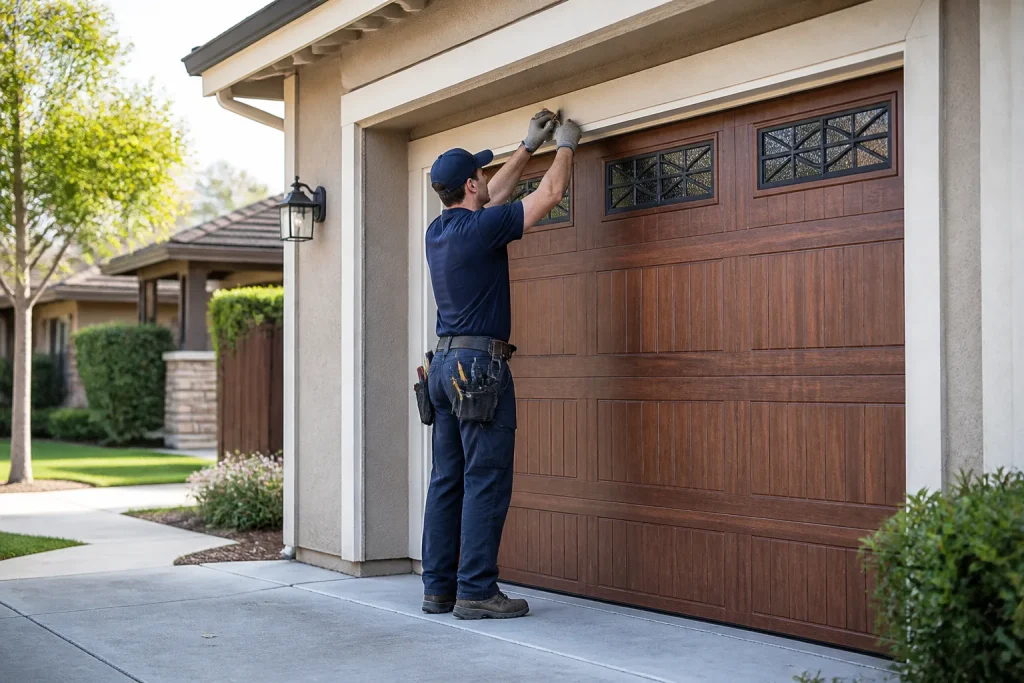
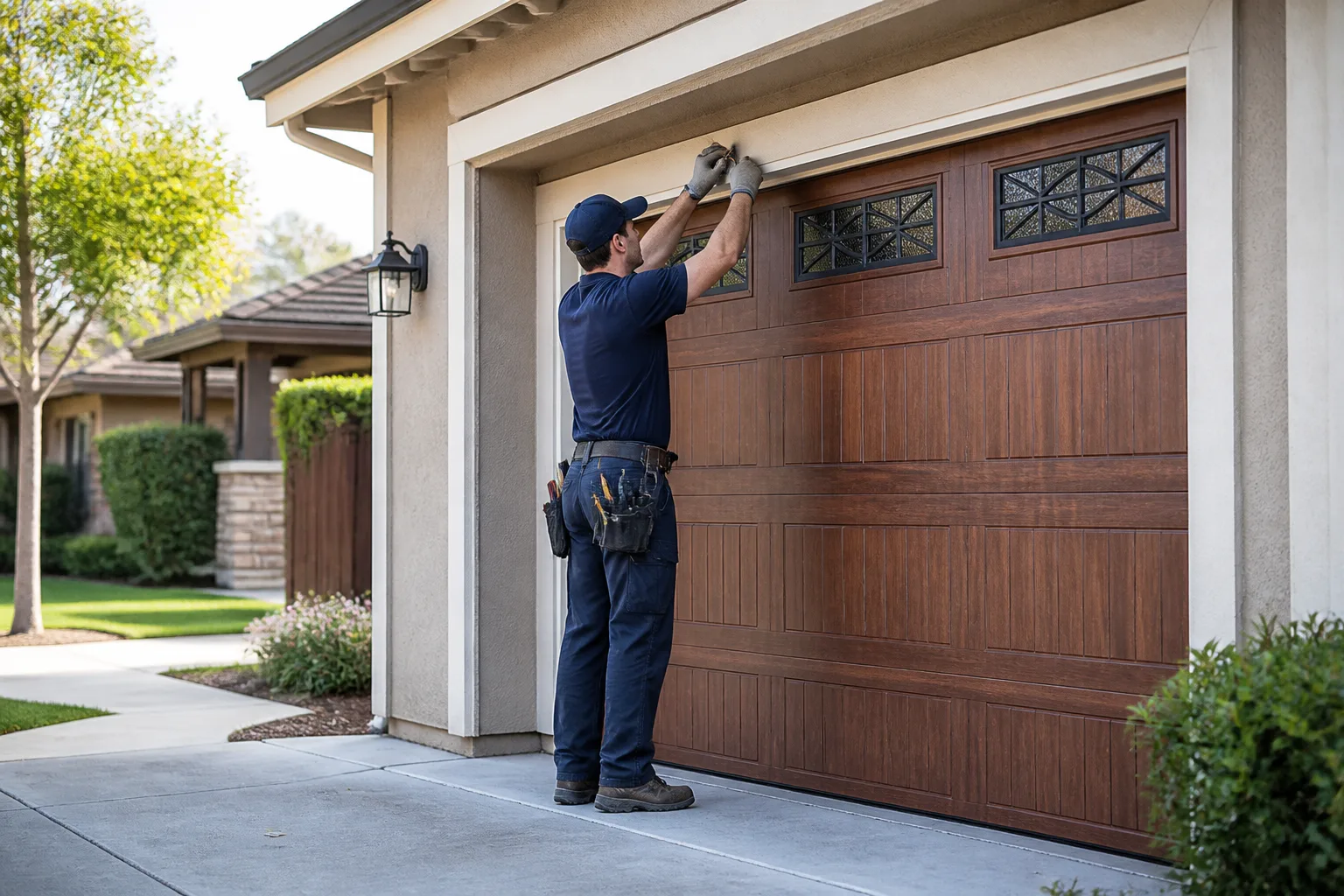
Amarr Garage Door Repair in San Jose: A Homeowner’s Guide
Amarr garage door repair in San Jose typically runs $180–$420 depending on whether you’re fixing a broken spring, replacing a cracked end stile, or addressing opener issues. Most Amarr-specific problems we see aren’t actually spring failures — they’re section-joining hardware and end-stile cracks that get misdiagnosed by techs unfamiliar with Amarr’s construction. If you’d rather not sort this out yourself, Beacon Garage Door California offers free estimates — call (866) 780-5452.
Here’s the call we get constantly: a homeowner in Willow Glen or Almaden Valley has been quoted $280–$350 for a “bent track replacement” when what’s actually failing is a $40 end-stile reinforcement on their Amarr steel door. We’ve been running repair calls across San Jose for nine years, and this particular misdiagnosis costs people money every single week. Amarr builds a solid door, but the way their sections connect and where stress concentrates isn’t obvious unless you’ve worked on hundreds of them.
How Amarr’s Model Lineup Affects What Breaks First
Amarr makes several residential steel lines you’ll encounter in San Jose neighborhoods, and the construction differences directly predict your failure points:
- Heritage (single-layer 25-ga steel): The lightest and most common in older San Jose tract homes. The 25-gauge steel flexes more, so hinge points and end stiles take more cyclic stress. We see cracked end stiles on Heritage doors after 8–12 years in San Jose’s climate.
- Stratford (double-layer with vinyl back): Better insulation, but the added weight loads the section-joining hardware differently. The vinyl-backed sections are also more susceptible to moisture trapping in our Bay Area humidity, especially in garages that aren’t climate-controlled.
- Lincoln (triple-layer with polyurethane): Heaviest and most rigid. The hardware lasts longer, but when it does fail, the repair requires heavier-duty components. Don’t let a tech substitute standard hinges — the gauge mismatch will accelerate wear.
The steel gauge matters because thinner steel (higher gauge number) deforms more at attachment points. In San Jose, where many garages face afternoon sun exposure that heats and cools the door daily, that thermal cycling adds up. We’ve replaced end stiles on Heritage doors in Cambrian Park that were only seven years old because the expansion and contraction worked the steel at the hinge mount until it cracked.
If you’re unsure which Amarr model you have, check the sticker on the interior side of the door — usually on an end stile or the top section. The model name and gauge should be printed there.
The End-Stile and Section-Joining Failure Pattern
This is the big one. Amarr’s end stiles — the vertical steel channels at each side of every door section — are where we find the most commonly misdiagnosed problem in San Jose.
Here’s what happens: the end stile develops a crack or separation at the hinge attachment point. The door starts to bind slightly in the track. A tech who hasn’t worked much on Amarr doors sees the binding, assumes the track is bent, and quotes a track replacement. The track gets swapped, the door still binds, and now you’re into a second service call.
We pulled one out of a garage over in Blossom Valley last month where exactly this had happened. The homeowner had already paid another company for a “track alignment” that did nothing. The actual issue was a cracked left-end stile on the second section from the bottom — visible once you knew to look for a hairline crack running from the hinge bolt hole toward the panel face. A $38 end-stile reinforcement bracket and 20 minutes of work. Done.
What to check before calling anyone:
- Disconnect the opener and run the door manually. Does it bind at the same height every time?
- Look at the end stiles (the vertical edges of each section) with the door closed. Do you see any cracks radiating from hinge bolt holes?
- Check whether the door hangs level in the opening. A failed end stile on one side often creates a visible tilt.
If you see cracks, stop running the door. The end stile is structural, and a complete separation can drop a section or jam the door entirely. This is when to call a pro — not because the repair is complex, but because misdiagnosis is expensive.
Amarr’s Warranty: What’s Covered and What’s Practical
Amarr offers a limited lifetime warranty on certain components, but the structure matters for San Jose homeowners deciding between a warranty claim and a local repair.
Coverage breakdown:
- Sections/panels: Typically 10 years to lifetime depending on the model, but only for manufacturing defects — not impact damage, rust from scratches, or environmental degradation.
- Hardware (springs, hinges, rollers): Usually 3–5 years, and this is where it gets tricky. Amarr’s warranty covers hardware that fails due to defect, not normal wear. A spring that breaks after 8 years of cycles isn’t a warranty issue — it’s expected lifespan.
- Finish/paint: Limited coverage for peeling or fading, but surface rust from scratches or coastal air exposure is excluded.
The practical reality in San Jose: warranty claims go through your original dealer or an authorized Amarr distributor. If you didn’t buy from a dealer who’s still in business, or if your door is past the original install warranty period, the administrative overhead often exceeds the repair cost. We’ve had homeowners in Evergreen spend two weeks chasing a warranty authorization for a $45 hinge kit.
For most repair scenarios — cracked end stiles, worn rollers, spring replacements — a local repair is faster and often comparably priced once you factor in time and the $75–$125 service call a dealer typically charges just to evaluate warranty eligibility.
Sourcing Amarr Parts in San Jose Without the Truck Markup
Here’s something most San Jose homeowners don’t know: many garage door repair companies mark up parts 150–300% over their cost, then add a “parts sourcing fee” on top. For Amarr-specific components, you have options.
Direct paths:
- Amarr’s dealer locator: Finds authorized distributors who sell parts to homeowners. The closest to central San Jose is typically in San Jose or Santa Clara.
- Regional suppliers: Companies like North Bay Industries and some San Jose-area door wholesalers sell to the public with a valid door model number. You’ll need the model and often the serial number from your door sticker.
- Online: Amarr parts are available through several garage door supply sites, but shipping times run 5–10 days. Fine for planned maintenance, not for a door that’s stuck open.
The catch: knowing exactly what part you need. An “end stile” for a Heritage 25-gauge isn’t the same as an end stile for a Lincoln 24-gauge. The hole spacing, steel thickness, and reinforcement profile differ. We’ve had homeowners in Almaden order the wrong part twice before calling us.
If you’re handy and can accurately identify the component, self-sourcing saves money. If you’re not certain, the wrong part costs more than the markup you’d pay a tech who knows Amarr’s line well enough to bring the right piece on the first visit.
Paint, Rust, and Bay Area Humidity: Cosmetic vs. Structural
San Jose’s climate is milder than coastal Bay Area cities, but our winter humidity and summer temperature swings still stress garage door finishes. Amarr’s baked-on enamel holds up well, but no paint survives a decade of garage conditions without attention.
What we see in San Jose:
- Surface rust at panel edges or scratches: Usually cosmetic. Sand with 220-grit, prime with rust-inhibiting primer, touch up with color-matched paint. Amarr’s color codes are available if you have the original order information.
- Bubbling or blistering under the paint: Often indicates moisture trapped between the steel and the finish, especially on Stratford vinyl-backed doors where condensation forms behind the panel. This can progress to panel delamination — structural, not cosmetic.
- Rust bleeding from inside the end stile or section seam: Structural concern. Water has entered the hollow section and is corroding from the inside out. We’ve replaced sections in West San Jose where the interior rust had reduced the steel to flakes, but the exterior looked merely “weathered.”
For coastal-influenced areas of San Jose — near the bay or in lower-lying neighborhoods with poor garage ventilation — check the bottom sections annually. Road salt from winter rains and salt air intrusion accelerate corrosion at the base where panels contact (or nearly contact) the concrete.
When to Call a Pro for Amarr Repairs
Some Amarr issues are straightforward DIY if you’re mechanically inclined: lubricating rollers, tightening loose hardware, replacing a weatherstrip. Others aren’t worth the risk.
Call a pro if:
- The door has a broken spring. Torsion springs store massive energy and can cause serious injury or death if handled improperly.
- You see cracks in end stiles or section joints. These are structural and misdiagnosis is common.
- The door is off-track or cables are loose. The counterbalance system is dangerous to work around without training.
- You’re unsure of the part number or model variant. Wrong parts damage other components.
Kevin and his team at Beacon Garage Door California work on Amarr, Clopay, Wayne Dalton, and Craftsman systems regularly. Garage Door Repair in San Marcos and surrounding areas is also available through our service network.
The Bottom Line
Amarr doors are well-built, but their construction details — end-stile design, section-joining hardware, gauge-dependent stress points — reward technicians who know the brand. The most expensive repair is the one that doesn’t fix the actual problem. In San Jose, we’ve seen misdiagnosed end-stile failures turn a $40 bracket into a $300 track replacement plus a callback.
If you’re in San Jose and your Amarr door is binding, noisy, or showing cracks at the hinges, we’ll tell you what it actually needs. No upsell, no guessing. Beacon Garage Door California offers free estimates — call (866) 780-5452.
Frequently Asked Questions
Most Amarr repairs in San Jose run $180–$420. A standard spring replacement is typically $180–$280, end-stile or hinge repairs run $120–$220, and opener-related issues range $200–$420 depending on whether it’s a repair or full replacement. Call (866) 780-5452 for an exact quote — estimates are free.
Repair is usually the better value if the door is under 15 years old and the panels aren’t delaminating or severely rusted. A new steel Amarr door installed runs $1,200–$2,800 in the San Jose market, so a $200–$400 repair pays off if it extends service life by several years. We’ll tell you honestly if we’re approaching replacement territory.
We offer emergency garage door service for urgent situations — doors stuck open, broken springs, or security-compromising failures. For standard repairs, we typically schedule within 1–2 business days across San Jose. Call (866) 780-5452 to check current availability.
Any competent garage door technician can repair an Amarr door — the components are standard in terms of function, even if Amarr-specific in dimension. The key is finding someone who recognizes Amarr’s particular failure patterns (end-stile cracks, section-joining stress) rather than treating it generically. Kevin and his team have worked on Amarr systems for nine years and carry the specific hardware for common repairs.
Written by Kevin Ardila, Founder & Lead Installer at Beacon Garage Door California, serving San Jose since 2017.
Need Garage Door Help?
Call Beacon Garage Door California — licensed & insured, here with fast after-hours help in California.
(866) 780-5452